

How Long After Tooth Extraction Can You Get an Implant? Immediate, Early and Delayed Placement Explained
How long after tooth extraction can you get an implant? It can be the same day, after about 4–8 weeks, or after 3–6 months or more, depending on infection, bone and which tooth is missing. This guide from our clinic in Gümüşsuyu, Beyoğlu, near Taksim Square in Istanbul, explains each option.
Last updated: 24 November 2026
Quick answer: how long after tooth extraction can you get an implant?
You can get an implant on the day of the extraction (immediate placement), after about 4–8 weeks once the gum has healed (early placement), after 12–16 weeks with partial bone fill, or after roughly 4–6 months or longer in a fully healed site (delayed placement). Infection, bone volume and tooth position decide which is safest.
These windows come from the International Team for Implantology (ITI) consensus classification. The final decision follows an exam and a 3D CBCT scan.
Not sure how long you should wait?
Send us your X-ray or the date of your extraction, and our team in Taksim will explain which timing could suit you.
WhatsApp us: +90 534 445 94 44Important medical note
This article is general information and does not replace an examination. The right timing depends on your CBCT scan, bone and gum, any infection and your general health. Time frames are typical ranges from the literature, not promises; results vary.
What are the main options for implant timing after an extraction?
There are four recognised time points for placing an implant after a tooth is removed, defined by how far the soft tissue and bone have healed rather than by a fixed calendar date.
The 2004 ITI consensus by Hämmerle and colleagues, as summarised in a 2026 scoping review in the Journal of Clinical Medicine, describes them as follows:
| Type | Name | Typical time after extraction | What has healed |
|---|---|---|---|
| Type 1 | Immediate placement | Same day, same surgery | Nothing yet: implant goes into the fresh socket |
| Type 2 | Early placement with soft tissue healing | About 4–8 weeks | Gum has closed over the socket |
| Type 3 | Early placement with partial bone healing | About 12–16 weeks | Clear bone fill seen clinically or on X-ray |
| Type 4 | Delayed (late) placement | More than 16 weeks; often described as over 6 months | Fully healed ridge |
A later ITI consensus (2018), quoted in the same review, groups Types 2 and 3 as "early placement" and defines late placement as more than 6 months after extraction.
Can you get an implant the same day as a tooth extraction?
Yes, an implant can often be placed in the same appointment as the extraction, but only when the socket is free of acute infection, the thin outer bone wall is intact and the implant can be held firmly in the surrounding bone.
This is immediate implant placement. The Cochrane review by Esposito and colleagues lists its benefits (shorter treatment, possibly better preserved bone) and possible disadvantages: a higher risk of infection and failure, and gaps around the implant that may need graft material.
Who is usually a good candidate for an immediate implant?
According to the 2026 scoping review in the Journal of Clinical Medicine, patients selected for immediate placement should be systemically healthy, non-smoking adults with good oral hygiene, and the tooth should be removable gently with an intact buccal (outer) socket wall.
- no swelling, pus or active abscess at the tooth;
- an intact outer bone wall seen on the CBCT scan;
- a thick gum type, especially for front teeth;
- no heavy smoking and no poorly controlled diabetes.
For a single missing tooth, see our page on single tooth implants in Istanbul.
What is early implant placement 4–8 weeks after extraction?
Early placement means waiting about 4–8 weeks until the gum has closed over the socket, then placing the implant, usually with bone grafting to rebuild the ridge contour.
This is popular for front teeth. In their systematic review in the International Journal of Oral & Maxillofacial Implants, Chen and Buser found that immediate (Type 1) implants in the upper front area had recession of the gum line greater than 1 mm in 9% to 41% of sites (median 26%) one to three years after placement. In the two studies of early (Type 2 and 3) placement, no sites had recession of more than 1 mm.
With early placement plus contour grafting, the facial bone wall was visible on CBCT in over 90% of sites; after immediate placement with graft, it was undetectable in 36% and 57% of sites in two studies.
Type 3 placement at 12–16 weeks is often chosen after infection or when the socket was large.
When is delayed implant placement after 3–6 months the better choice?
Delayed placement, usually 3–6 months or more after extraction, is preferred after severe infection, large bone loss or a cyst, or when general health calls for full healing first.
Waiting lets infection clear and new bone fill the socket, but the ridge shrinks after tooth loss, so a longer gap makes a graft more likely. Cleveland Clinic notes that if there is not enough jawbone to support an implant, bone grafts may be needed to build up areas of bone loss.
Do immediate implants fail more often than delayed implants?
Large reviews show a small but measurable difference: implants placed in fresh sockets failed slightly more often than those placed in healed bone, although both had high survival overall.
A meta-analysis by Chrcanovic, Albrektsson and Wennerberg in the Journal of Dentistry pooled 73 publications. Of 8,241 implants placed in fresh extraction sockets, 4.00% failed, compared with 3.09% of 19,410 implants placed in healed sites (risk ratio 1.58). The authors found no significant effect on postoperative infection or marginal bone loss, and advised caution because most studies were not randomised.
The Cochrane review found insufficient evidence to settle the question, suggesting immediate and immediate-delayed implants may carry more failures and complications, while aesthetics might be better with immediate placement.
Does it matter whether it is a front tooth or a back tooth?
Yes. For front teeth the concern is how gum and bone look over time; for molars it is whether the wide socket leaves enough bone to hold the implant firmly.
Front teeth: the outer bone wall is often very thin, so the gum line can shrink after an immediate implant; many clinicians prefer early placement unless bone and gum are thick.
Back teeth (molars): a molar has two or three roots, leaving a wide socket. A systematic review by Ragucci and colleagues in the International Journal of Implant Dentistry analysed immediate implants in molar sockets and reported a weighted mean survival rate of 96.6% and a success rate of 93.3% after one year, with mean marginal bone loss of 1.29 mm. When the bone between the roots is thin, waiting is often safer.
In the upper back jaw a sinus lift may be needed. For very advanced bone loss, our partner clinic explains an alternative in its guide to zygomatic implants in Turkey.
What is socket preservation, and does it change how long you wait?
Socket preservation is a bone graft placed in the empty socket at the time of extraction to limit ridge shrinkage, so that an implant can be placed later in a better-shaped ridge.
According to Cleveland Clinic, initial recovery after a bone graft takes about a week, but the graft itself needs at least three months to heal; large grafts may need 9–12 months. Cleveland Clinic also advises that once a bone graft has healed, the implant should ideally be placed within 6–12 months, before the new bone starts to shrink and lose density.
For more detail, read our partner guides on bone graft surgery for dental implants and the dental bone graft guide on Dental Implants in Turkey.
Which factors decide how long you should wait for an implant?
Five factors drive the timing more than any calendar rule.
- Infection: an acute abscess, swelling or pus usually needs to settle first. See dental abscess treatment in Istanbul.
- Bone volume and the outer bone wall: checked on a 3D CBCT scan. Missing or very thin bone often means grafting and a staged approach.
- Front or back tooth: aesthetics in the smile zone, socket size and sinus position in the back.
- Smoking: a meta-analysis in the Journal of Dentistry found failure in 6.35% of 19,836 implants in smokers versus 3.18% of 60,464 implants in non-smokers, with more postoperative infections and more marginal bone loss in smokers.
- Diabetes and general health: Cleveland Clinic lists unmanaged diabetes, active gum disease and severe jaw bone loss among the conditions that may make implants less suitable until they are treated. Our partner page on dental care for diabetic patients explains more.
How does an implant after extraction work, step by step?
Whatever the timing, treatment follows the same sequence.
Durations are indicative; your dentist decides them after examination.
Can you still get an implant if the tooth was lost years ago?
Usually yes. The main question is how much bone remains, which a CBCT scan answers; some patients need a graft first, and those missing several teeth may be better served by All-on-X dental implants in Istanbul.
How should you plan an Istanbul trip around the healing time?
For patients travelling to Istanbul, implant treatment usually means two visits a few months apart, with healing at home in between.
- Visit 1: consultation, CBCT, extraction and, if suitable, an immediate implant or a graft. A temporary tooth can often be provided for visible areas.
- Healing at home: typically about 3–6 months, during which your bone integrates with the implant or the graft matures. Follow the instructions in this tooth extraction aftercare guide.
- Visit 2: checks, impressions or digital scan, and fitting of the final crown or bridge.
Our clinic is a short walk from Taksim Square, with many hotels nearby and road links from Istanbul Airport and Sabiha Gökçen. Our page on dental treatment in Turkey, step by step explains each stage of the trip.
Watch: dental implants in Istanbul, step by step
In this one-minute video, Dr. Abdurrahman Öztürk walks through implant treatment in Istanbul: consultation and 3D CBCT scan, implant placement under local anaesthesia, healing of about 3–6 months, and the final crown or bridge.
Warning signs after an extraction or implant
Contact your dentist promptly if pain worsens after the third day, swelling increases, or you notice pus, fever or a bad taste.
- severe throbbing pain a few days after extraction (possible dry socket);
- numbness of the lip or chin that does not wear off.
Facial swelling with fever, or swelling that affects breathing or swallowing, needs urgent medical care.
Why plan your implant timing with Taksim Clinics in Istanbul?
Taksim Clinics is a dental clinic in Gümüşsuyu, Beyoğlu, near Taksim Square, led by Dr. Abdurrahman Öztürk, treating local and international patients.
We plan implant timing with 3D CBCT and prefer the safer option when infection or bone loss is present. Read more about dental implants in Istanbul at our clinic. To see how AI-supported planning can help position a single implant, visit our sister clinic's page on AI single tooth implants in Istanbul.
Medically reviewed by: Dr. Abdurrahman Öztürk
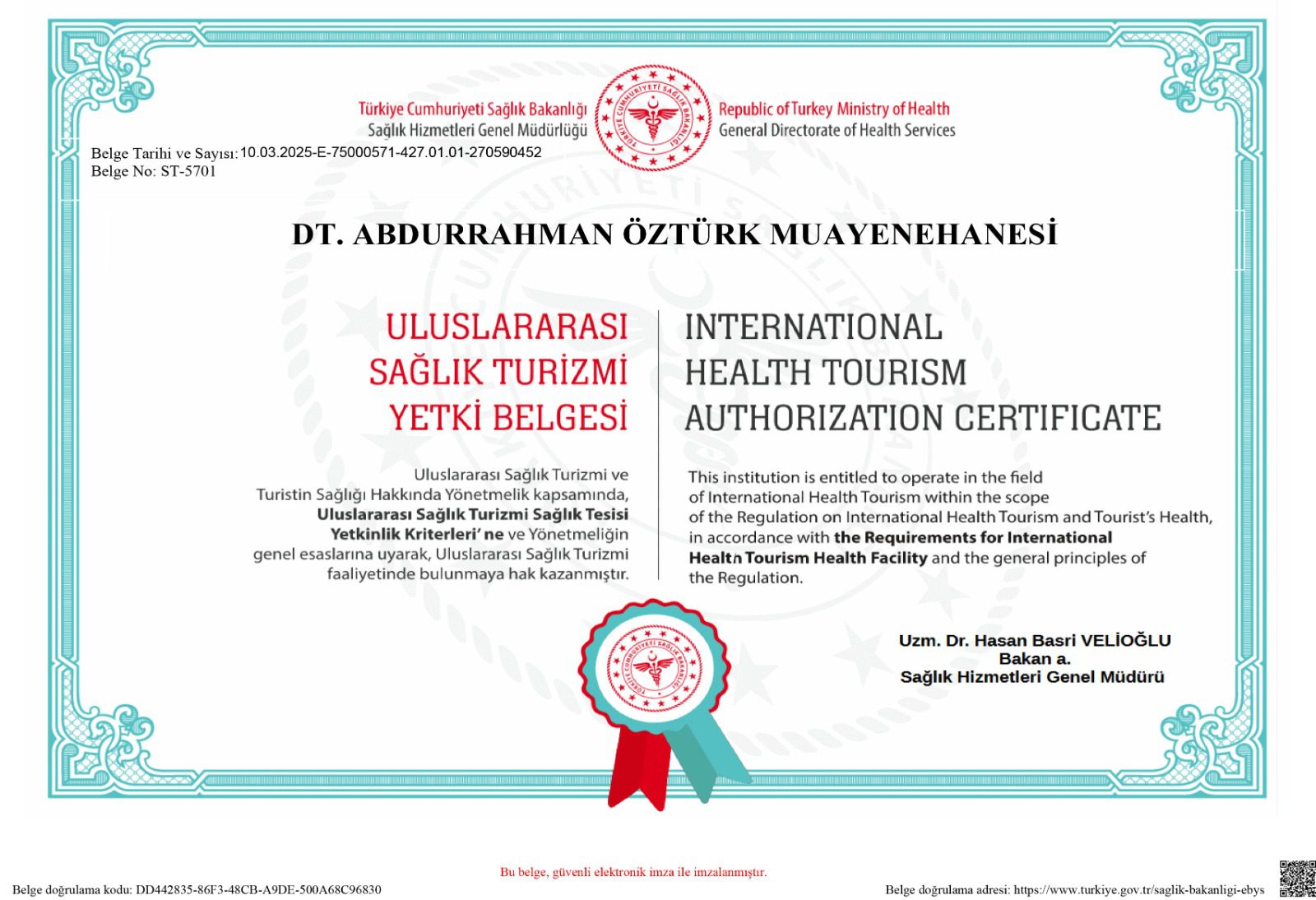
Dentist and medical lead of Taksim Clinics. He holds a doctorate in dentistry and jaw surgery and has more than 15 years of experience in dentistry and dental surgery. The practice is licensed by the Turkish Ministry of Health and holds an International Health Tourism Authorization. Meet your dentist.
Clinic location: Gümüşsuyu Mah., Mete Cad., Beyoğlu, Istanbul
Taksim Clinics · Gümüşsuyu Mah., Mete Cad., Beyoğlu, Istanbul, Türkiye · Phone and WhatsApp: +90 534 445 94 44
Directions are also on our contact page.
Key takeaways
- An implant can go in the same day, after about 4–8 weeks, after 12–16 weeks, or after 4–6 months or more.
- For front teeth, early placement has shown less gum recession than immediate placement in reviewed studies.
- Smoking roughly doubled implant failure in a large meta-analysis (6.35% vs 3.18%).
- A CBCT scan and examination decide the timing, not a fixed calendar rule.
More implant and extraction guides
Single tooth implants in Istanbul Surgical tooth extraction in Istanbul Wisdom tooth removal in Istanbul Dental treatment in Turkey, step by step Bone graft surgery for dental implants (Dr. Abdurrahman Öztürk) Dental bone graft guide (Dental Implants in Turkey) AI single tooth implant in Istanbul (AI Dent Clinic)Ask us when your implant can be placed
Message us on WhatsApp with your X-ray, the date of your extraction and any symptoms. The timing is decided only after an examination.
WhatsApp: +90 534 445 94 44 Call +90 534 445 94 44 Taksim Clinics home pageHow long after tooth extraction can you get an implant: FAQ
Can I get an implant immediately after a tooth extraction?
Often yes, if the socket is free of acute infection, the outer bone wall is intact and the implant can be anchored firmly. Your dentist confirms this with an examination and a CBCT scan.
How long can I wait after extraction before getting an implant?
There is no strict deadline, but the ridge shrinks after a tooth is lost, so a long gap makes a bone graft more likely. If a graft was placed, Cleveland Clinic advises placing the implant within 6–12 months after the graft heals.
Do I need a bone graft after an extraction?
Not always. A socket preservation graft is used when the implant will be delayed or the bone walls are damaged.
Is an immediate implant riskier than a delayed one?
Slightly: one meta-analysis reported failure in 4.00% of implants in fresh sockets versus 3.09% in healed sites. Case selection matters most.
Can an infected tooth be replaced with an implant on the same day?
With an acute abscess, swelling or pus, most dentists treat the infection first and place the implant later. Mild, chronic conditions are judged case by case after a scan.
Does smoking affect how long I should wait?
Smoking raises the risk of implant failure and infection. A meta-analysis found failure in 6.35% of implants in smokers versus 3.18% in non-smokers, so stopping before and after surgery is strongly advised.
How long does the whole process take from extraction to final crown?
Usually several months: Cleveland Clinic states that bone takes three to nine months to fuse with the implant, plus any graft healing time.
How many trips to Istanbul will I need?
Most implant patients need two visits a few months apart: one for extraction and implant or graft, one for the final crown.
Conclusion: how long after tooth extraction can you get an implant?
How long after tooth extraction can you get an implant depends on your socket, not the calendar: same day when conditions are right, about 4–8 weeks or 12–16 weeks when healing helps, and 3–6 months or more after severe infection or bone loss. The Taksim Clinics team in Beyoğlu, Istanbul, plans the timing with a CBCT scan so the implant has the healthiest possible foundation.
Sources
- Phrai-in N, et al. From Biological Mechanisms to Clinical Outcomes: A Scoping Review Comparing Immediate and Delayed Dental Implant Placement Protocols. J Clin Med. 2026;15(2):682. PMC
- Chen ST, Buser D. Esthetic outcomes following immediate and early implant placement in the anterior maxilla: a systematic review. Int J Oral Maxillofac Implants. 2014;29 Suppl:186-215. PubMed
- Chrcanovic BR, Albrektsson T, Wennerberg A. Dental implants inserted in fresh extraction sockets versus healed sites: a systematic review and meta-analysis. J Dent. 2015;43(1):16-41. PubMed
- Esposito M, et al. Interventions for replacing missing teeth: dental implants in fresh extraction sockets (immediate, immediate-delayed and delayed implants). Cochrane Database Syst Rev. 2010;(9):CD005968. PMC
- Ragucci GM, et al. Immediate implant placement in molar extraction sockets: a systematic review and meta-analysis. Int J Implant Dent. 2020;6:40. PMC
- Chrcanovic BR, Albrektsson T, Wennerberg A. Smoking and dental implants: a systematic review and meta-analysis. J Dent. 2015;43(5):487-98. PubMed
- Cleveland Clinic — Dental Implants. my.clevelandclinic.org
- Cleveland Clinic — Dental Bone Graft. my.clevelandclinic.org